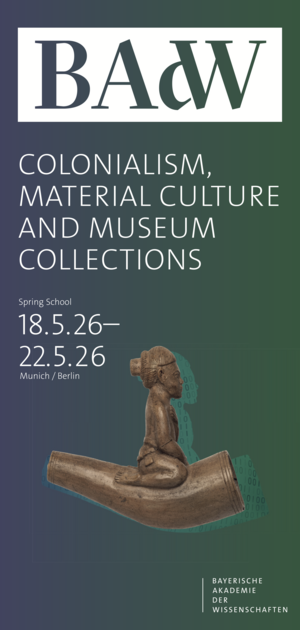
Call for Participation: Spring School “Colonialism, Material Culture and Museum Collections”
| Dates | 11–15 May 2026 · Deadline for Applications: 2 January 2026 |
| Location | Bavarian Academy of Sciences and Humanities · Alfons-Goppel-Straße 11, 80539 München |
| Host | Project “From Collection to Collaboration: Revisiting the Colonial Philippine Collection of Heinrich Rothdauscher (1851–1937) at the Museum Fünf Kontinente in Munich” (Funded by German Lost Art Foundation), a joint project of the Bavarian Academy of Sciences and Humanities, the University of Bamberg (Centre for Heritage Conservation Studies and Technologies / KDWT) and the Museum Fünf Kontinente |
Introduction
For centuries, European scholars, explorers and travellers have traversed the globe in pursuit of uncharted natural landscapes, peoples and cultures. In order to visualise the “primitivity” of the indigenous peoples and to demonstrate the differences between the European and the “others”, the collection of skulls, everyday artefacts and ritual tools became a standard practice in the European colonial expansion. These objects were frequently taken away from their original communities without explicit consent, and transported to Europe for scientific, educational and/or amusement purposes. Until today, the artefacts collected in the colonial context continue to be exhibited in cultural, anthropological and ethnological museums across Europe. The scientific research and public understanding of non-European cultures are predominantly influenced by the ways in which these objects are interpreted and represented. In order to establish a foundation for decolonial knowledge on these objects, it is necessary to place them within their native, colonial and transnational contexts.
The Spring School will be hosted by the Bavarian Academy of Sciences and Humanities. The Spring School constitutes a crucial part of the research project “From Collection to Collaboration: Revisiting the Colonial Philippine Collection of Heinrich Rothdauscher (1851–1937) at the Museum Fünf Kontinente in Munich”. From 1873 to 1883, the German pharmacist resided in the Philippines and was profoundly interested in collecting artefacts from the Spanish colony at the time. Despite the absence of a formal German territorial occupation in the Philippines, the collecting practice of Rothdauscher was evidently embedded in the colonial context of the land. Following his return to Germany, Rothdauscher donated 112 objects from his collection to the Royal Ethnographic Collection in Munich. These objects were considered to be among the earliest collections of Philippine artefacts in Germany.
With the support of the Museum Fünf Kontinente and the University of Bamberg (Centre for Heritage Conservation Studies and Technologies / KDWT), the Spring School will concentrate on Rothdauscher’s collection of the Philippines and focus on the following questions:
- From which perspectives should the histories of colonial collections in Europe be presented in order to acknowledge the cultural significance of the objects and the violence associated with the acquisition process?
- Are there unconventional and innovative ways to exhibit the colonial collections in museums, and to represent the historical dynamics in process of intercultural encounters?
What will you gain from the Spring School?
- Explore colonial collections of the Philippines in German museums and archives;
- Get hands-on experience with photogrammetry and 3D scanning technologies and methods for preserving cultural heritage;
- Collaborate across cultures while critically rethinking museum practices and the legacies of colonial collections;
- Connect directly with Philippine and German experts in digital curation, provenance research, and colonial history;
- A certificate of the participation issued by the Bavarian Academy of Sciences and Humanities.
Expenses covered
For participants from the Philippines:
- Round-trip flight tickets (Philippines-Germany) and train tickets (Munich-Berlin): max. € 1,300 per person;
- Visa fees: max. € 120 per person;
- Accommodation in Munich and Berlin with encluded breakfast: 10–15 May 2026.
For participants from Germany:
- Round-trip transportation to Munich and train tickets from Munich to Berlin: max. € 250 per person;
- Accommodation in Munich and Berlin with encluded breakfast: 10–15 May 2026.
Application for a Schengen Visa
Participants with Philippine nationality are required to hold a visa when travelling to Germany. It is recommended to apply for a standard Schengen Visa, which allows Philippine citizens to travel to Schengen countries for up to 90 days within a 180-day period. Each individual must complete and submit their own application form in person, along with the required documents, at VFS Global in Manila or Cebu. The Bavarian Academy of Sciences and Humanities will issue an invitation letter for each participant. The accruing fees by visa application will be covered by the Spring School.
For Schengen visa applications, please refer to the instructions on the website of the German Embassy Manila: https://manila.diplo.de/ph-en/service/visa/2543948-2543948?openAccordionId=item-2439838-1-panel
Participant Requirements
- Graduate and PhD students who are registered at a university in either the Philippines or Germany;
- Majoring in (art) history, (cultural) anthropology, ethnology, museum studies, digital humanities or material culture;
- Open-minded about intercultural communication and cooperation.
Application
Interested applicants for the Spring School should send a CV and a short letter of motivation (max. 3000 characters) to Pai-Li Liu (PaiLi.Liu@shr.badw.de) by 2 January 2026.
For further questions, please contact PaiLi.Liu@shr.badw.de.